
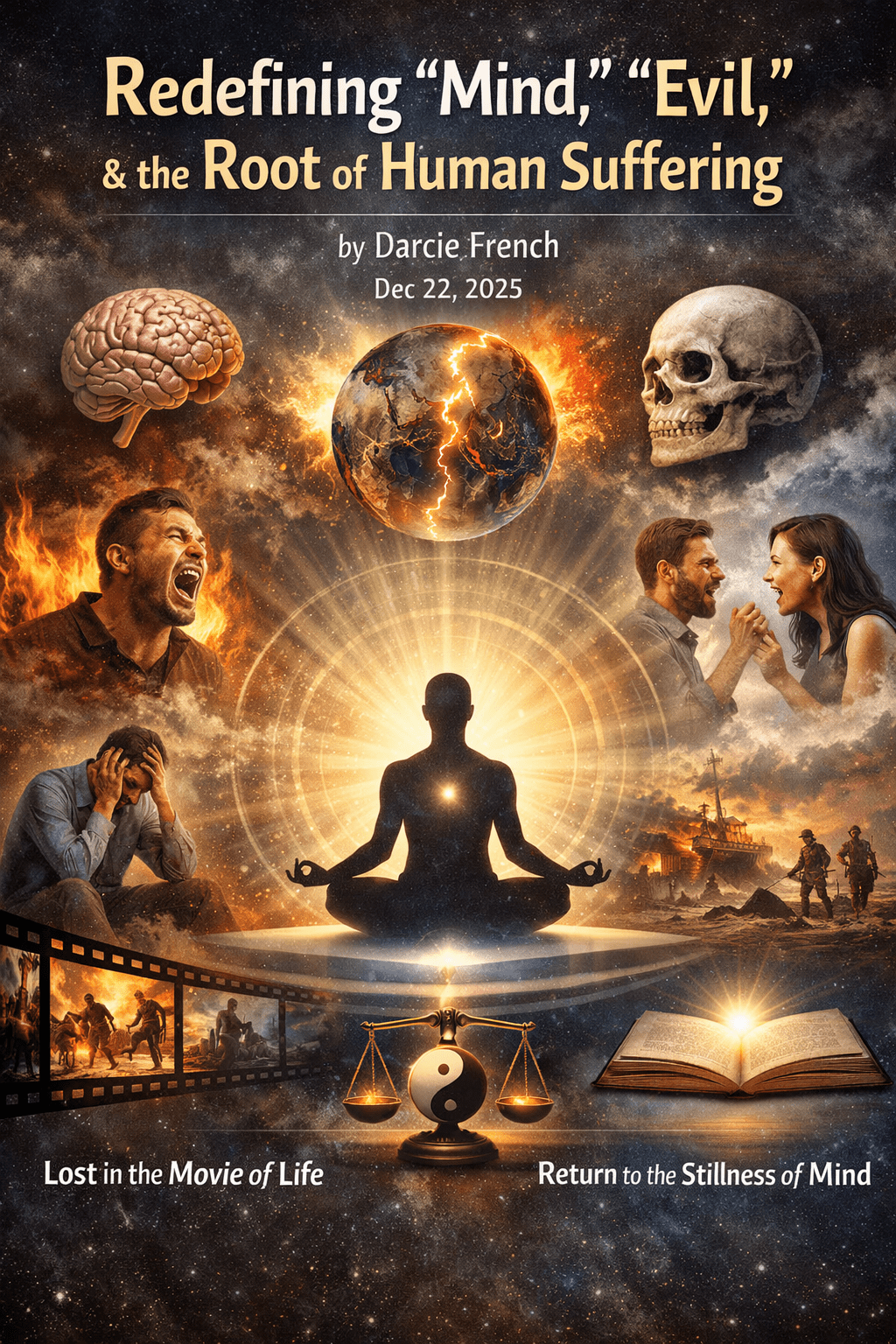
Introduction: The Self-Improvement Trap
Most of us are caught in a lifelong project of self-improvement. We try to fix our thoughts, correct our behaviors, and manage our emotions, hoping to finally assemble a version of ourselves that is peaceful, effective, and free from suffering. But this effort can feel like a trap—an endless cycle of identifying flaws and applying temporary solutions, only to find the same core frustrations reappearing in new forms.
What if we’re trying to solve the problem in the wrong place entirely? What if the source of our struggles isn’t located in our psychology, our history, or our actions, but in a much more fundamental error? The esotericist Eugene Fersen pointed to this possibility in a single, cryptic sentence that offers a completely different diagnostic manual for the human condition.
“In this present stage of Evolution it becomes vitally important for Humanity to have a thorough knowledge of the Mind, and the laws that govern it. Evil — that is, the conscious or unconscious violation of the Laws of the Absolute, due to the reversal of the natural ascending movement of all vibrations — originated in Mind.”
When unpacked, this statement reveals a radical model for understanding ourselves. It’s not about becoming better; it’s about understanding where “you” are actually located. Let’s explore the five counter-intuitive takeaways hidden within this quote.
Takeaway #1: Your Mind Is Not Your Brain
Our modern world assumes that “Mind” is a product of the brain—a stream of thoughts, a collection of cognitive processes, a psychological landscape. We study it by analyzing its activity and its expressions.
The framework presented by Fersen and clarified by cosmologist Walter Russell proposes a startlingly different definition. Here, Mind is not the activity but the Cause of that activity. It is described as:
- Still
- Motionless
- Timeless
- The knowing center from which all motion is simulated
This redefines the very goal of self-awareness. To “know the Mind” is not to analyze your thoughts, emotions, or experiences. It is to recognize the true location of your identity. This location is referred to as the Rest Point—the sole, still reference of identity from which all else extends.
The profound implication is that our primary crisis is a fundamental misplacement of identity—a shift from Knowing to sensing. We have anchored our sense of self in the simulation rather than in the simulator.
Takeaway #2: “Evil” Is a Technical Glitch, Not a Moral Failing
The word “evil” comes with immense moral and religious baggage. We associate it with sin, darkness, malicious intent, or an active opposition to God.
Fersen and Russell strip away this moral framing entirely. In their model, “evil” is a functional term, not a moral one. It is simply imbalance, unbalanced thinking, or lawless motion. It describes a technical state, like a machine running incorrectly.
In this context, “evil” is the state of mis-referencing. It is the state of reaction instead of simulation—of identity anchored in motion instead of rest.
This is a profoundly liberating concept. It reframes human suffering, struggle, and destructive behavior not as a sign of being inherently “bad,” but as the predictable result of a correctable technical error. The problem isn’t a corrupt character; it’s a misplaced reference point.
Takeaway #3: Universal Laws Aren’t Rules, They’re Principles of Balance
When we hear about “The Laws of the Absolute,” our minds often jump to the idea of a cosmic rulebook—a set of top-down commandments we must obey to avoid punishment.
This interpretation is incorrect. According to this framework, these laws—identified as Balance, Love, Truth, and Law—are not ethical ideals or a moral code. They are the functional constraints of Creation. They are to the universe what physics is to an engineer.
The Law is simply “how motion must behave if it is to return to rest unchanged.” It’s a principle of functional harmony.
Any deviation from this principle is not met with punishment from an external authority. Instead, the deviation is inherently self-correcting. Imbalance, by its very nature, generates effects that drive it back toward balance. This shifts the entire dynamic from one of fearful obedience to one of intelligent alignment with the natural, functional order of things.
Takeaway #4: The Core Human Error Is Mistaking the Movie for the Screen
This brings us to the core mechanic behind the “technical glitch” we call evil: what Fersen calls the “reversal of the natural ascending movement.” The natural movement is one of balance: motion extends from a point of rest, expresses itself, and then returns to that same point of rest, complete and unchanged.
The “reversal” is what happens when our identity gets lost in the expression and forgets its source. It occurs when we chase the effect (the experience, the feeling, the outcome) instead of remaining in the cause (the still point of knowing). In this state, sensation is treated as knowing, and motion is mistaken for power. As Walter Russell puts it, we mistake “effect for cause.”
This is the fundamental glitch. We become so absorbed in the “movie” of our lives—the drama, the sensations, the narrative—that we forget our true self is the motionless “screen” on which it all plays. This reversal creates a condition that isn’t morally ‘downward,’ but functionally centrifugal, dispersive, and fragmenting—pulling our sense of self away from its coherent center.
Takeaway #5: The Solution Isn’t Self-Help, It’s an Ontological Reset
The most easily misunderstood line in Fersen’s quote is that evil “Originated in Mind.” This does not mean that the core of our being is corrupt or that Mind itself is the source of evil.
It means the error occurs before any action is ever taken. The distortion begins at the level of thinking and identity placement, long before it manifests as a behavior or an emotion. The mistake is ontological (an error in being) not ethical (an error in doing). This framework makes it clear:
The body never errs. Experience never errs. Only identity placement errs.
This leads to a solution that is a radical departure from conventional approaches. It is not therapy, behavior modification, emotional healing, or transcending the world. It is ontological correction.
The goal is not to fix the personality, heal the past, or become a “better” person. The goal is to relocate identity back to the Rest Point—the still center of Knowing. From this correct placement, balanced, lawful motion can once again arise naturally, extending and returning knowingly unchanged, just as it’s designed to.
Final Thoughts: Where Are You Standing?
The source of our deepest struggles, from this perspective, is neither psychological nor moral. It is architectural. It is a simple but profound misplacement of self, mistaking the fluctuating experiences of life for the silent, unchanging source of that life.
The entire project of “fixing ourselves” is based on this foundational error. The solution isn’t to rearrange the content of our experience, but to change the context from which we experience.
As you go through your day, ask yourself: Is my sense of “me” located in the ever-changing story of my experiences, or in the silent, knowing stillness from which it all emerges?
Darcie French Dec 23/2025
 Spiritualized Reality Therapy & Rest Point Recovery
Leave a comment